




Credit Score1
Build Your
Credit for a
Better Future

Check Your Score for FREE with Digital Banking
A Credit Score can range from 300 to 850 and is like a report card for your money habits. The higher your score, the more it shows lenders how well you manage loan repayments.
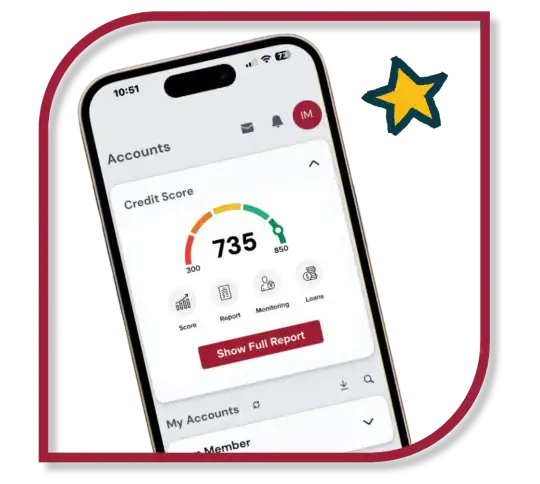
You have access to your Credit Score for FREE in digital banking. The Credit Score tool uses a soft inquiry, so it does not negatively impact your credit score, and you can check your score as often as you like. Plus, you get access to:
- Your FREE daily credit score
- FREE credit monitoring alerts
- Personalized credit report card
- Tips based on your credit activity

Strengthen Your Score
A strong credit score helps you get approved for loans and services, and leads to better interest rates and insurance premiums. Set Credit Score Goals with a 6, 12, 18, or 24-month timeline and track your progress with personalized recommendations. Check in regularly to monitor improvements, adjust your strategy, and stay on track toward stronger credit and long-term financial stability.
What Influences Your Score
Your credit score is based on several factors that reflect how you borrow and repay money. Focus on these core habits to improve or maintain your credit score.
Payment History
The most important factor in your credit score is payment history. On-time payments show lenders you are likely to pay back a loan. Make consistent on-time payments to strengthen your score.
Credit Utilization
Credit utilization measures how much of your available credit is in use. Generally, it’s best to try to keep your credit card balances below 30% of your total credit limit.
Credit History Length
Lenders also look at how long your credit accounts have been open. Typically, longer credit histories positively impact your score because they give lenders more information to review. Credit history length makes up 15% of your credit score.
Credit Mix
Lenders look at the different credit types you use. Having a mixture, such as mortgages, credit cards, and auto loans, may improve your credit score. Credit mix accounts for about 10% of your credit score.
Borrow With Us to Build Your Score
One of the best ways to build your score is to make consistent, on-time payments on a line of credit. Try one of our loans or credit cards to strengthen your credit profile.
Credit Builder Loan2
Credit Builder Loans help first-time borrowers, or borrowers with a less-than-perfect credit history, strengthen their score.
Secured Personal Loan3
Share Secured Loans are a low-risk way to grow your credit and your savings. You pledge a set amount of money, and we put these funds on hold and provide a loan for the amount.
Visa® Platinum Credit Card4
Get a Visa® Platinum Credit Card and build rewards. This card has no annual or balance transfer fees. Easily monitor your card use and your credit score in digital banking.
Share Secured Credit Card5
A Share Secured Visa Credit Card is secured by money already in your account with us. Enjoy all of the benefits of a credit card with a secured account.
Learn About Credit Scores with Money Moves6
This episode of Money Moves by KTVAECU has the scoop about credit scores and the secrets you need to kick-start yours! In this episode, we’ll break down the five factors that shape your credit score and share tips to get you started.
Credit Score FAQs
Can’t find your question about credit score? Contact Us
Credit allows you to borrow money and repay it over time. Your credit score helps lenders determine how likely you are to repay what you borrow.
Credit scores are calculated with information from your credit report. This includes your payment history, the types of credit you use, how long you’ve had credit, and how much credit you use compared to your limits. Credit bureaus get updates from lenders regularly to calculate your score.
Your score typically changes when new information is added to your report. Most lenders report account activity about once every 30 days, though this varies by lender. When new information is added to your credit report, your score may change.
Pay bills on time, keep credit card balances low, avoid applying for too much credit at once, check your credit reports for errors. If you’re new to credit, consider a credit-builder loan to establish positive credit history.
Yes. Check your credit score to understand your borrower profile and notice changes over time. Use your digital banking profile to check your score for free anytime.
Hard inquiries, also called pulls, happen when you apply for a loan or line of credit, and the lender requests to look at your official credit report. Hard inquiries may initially lower your score. They remain on your credit report for up to two years, but their impact on your score usually fades sooner. This is why it is important to keep hard inquiries to a minimum when possible.
A soft inquiry occurs when you check your own credit or when credit is reviewed for informational purposes. Soft inquiries usually do not affect your credit score. A hard inquiry occurs when you apply for a loan or credit account, and a lender reviews your credit report. Hard inquiries may cause a temporary, slight change in your credit score.
No. Check your score anytime in digital banking with no effect on your score.
Yes, except for the interest you pay. As you make each monthly payment on your loan, the amount of the payment minus the interest charged becomes available to you in your account.